

Two solutions have emerged in the development to increase the efficiency of technological recovery: Backup Services (BaaS) and Disaster Recovery Services (DRaaS). However, we often confuse DRaaS and BaaS services.
Comparing the differences between DRaaS and BaaS services:
Here are 3 main differences between the two types of services:
-
Resources and assets are protected.
-
Cost and recovery speed.
Data has rapidly become the currency of our modern world. Data is used by companies to provide their core services to customers. And it helps transform the company’s services by gathering business insights from more historical data.
Both BaaS and DRaaS focus on minimizing data loss in the event of a disaster. BaaS focuses solely on long-term data retention. Meanwhile, DRaaS services focus on short-term data retention. In addition, they maintain the infrastructure, system state, and security models on which those datasets run, and the speed at which workloads can resume after an event.
How to protect resources and assets.
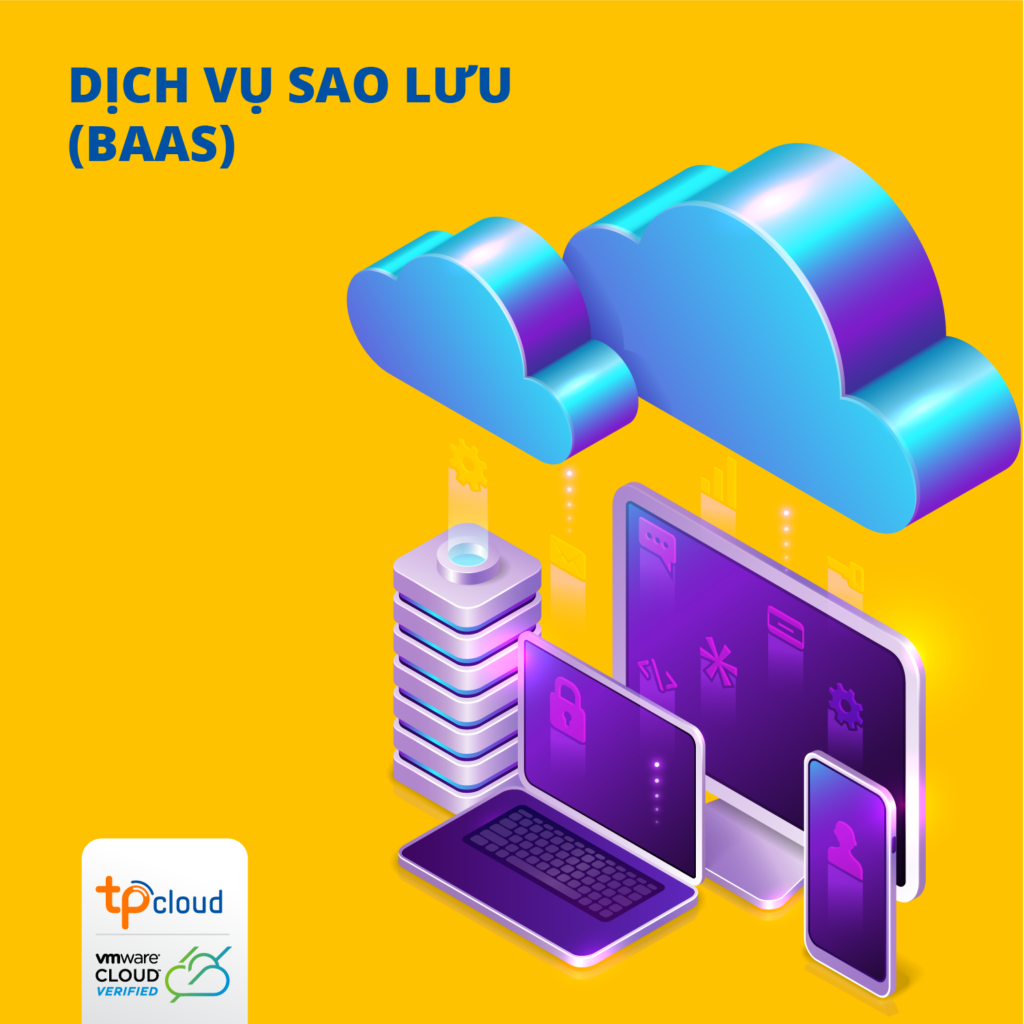
The management aspects of DRaaS and BaaS make both stand out from their predecessors. Both are cloud-based and managed by a third party. This is an attractive option for companies focused on business transformation. BaaS protects data by backing it up to both local devices and off-site cloud environments for secure storage. When data loss occurs, it can be recovered by selecting the appropriate dataset and replicating it to the original environment or, in the event of a disaster, to a recovery environment such as the cloud. It’s important to note that BaaS typically focuses on reducing the cost of data retention over the long term. Therefore, the recovery process can be longer. And in some cases, it can be costly if used for disaster recovery.
DRaaS services focus on recovery speed and therefore involve “replication” technology. In this, the provider continuously replicates data that has changed from your production environment to your cloud storage environment. From there, you can restore to the most recent iteration to minimize data loss and maintain security and system state; how the application being used was configured. During a disaster, you can “fail-switch” to the recovery environment so that you can simply run business operations from that location while the IT team repairs the original location. Comprehensive application and rapid recovery require mechanisms, coordination, and principles different from those of backup retention services.
TPCloud’s DRaaS service is a VMware vCloud Availability product.
The cloud makes recovery speed and targets achievable for both BaaS and DRaaS solutions. This is an advantage for businesses of all sizes and budgets. Today, companies can optimize costs by organizing their datasets into tiers. Here, they place the most critical systems and datasets at the highest tier of the DRaaS service. From there, recovery time is fastest. At the same time, the least critical datasets are placed at the lowest BaaS tier for the slowest recovery time.
BaaS services are often a good choice for the lowest recovery level, as they are cheaper than DRaaS services. On the other hand, DRaaS services are suitable for businesses looking to avoid managing their own data center or additional DR data center. Because recovery includes infrastructure, security, and system state restoration.
Hopefully, this article will help you gain more information about DRaaS services. If you are looking to rent a reputable Cloud DRaaS service, please consider TPCloud. This cloud server service based on the VMware platform offers many benefits in business operations or IT applications in production. If you have any needs, don’t hesitate to contact our hotline: (+84) 96803 6868 or visit http://www.tpcloud.vn/ for free consultation.