

In the era of digital transformation, security is no longer limited to recording, but requires smarter storage, access, and security capabilities. Previously, traditional camera systems were popular due to their low cost and ease of installation, but they revealed many limitations in terms of capacity, remote access, and maintenance.
The emergence of Cloud Cameras, also known as cloud cameras, has opened up a new approach. Data is no longer stored on hard drives or recorders, but is transmitted directly to the cloud infrastructure (Cloud Server), allowing for more centralized, flexible, and secure management.
According to Mordor Intelligence (2025-2030), the Asia-Pacific surveillance camera market is expected to grow at a CAGR of approximately 10.1%, from US$20.81 billion in 2025 to US$33.67 billion in 2030, showing a strong shift towards cloud-based surveillance platforms.
What is a Cloud Camera?
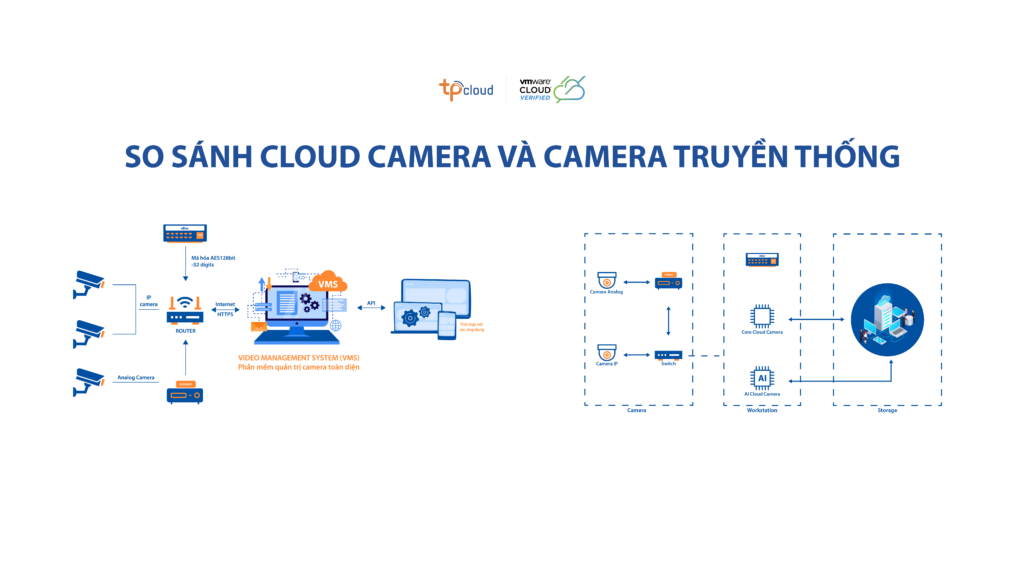
A Cloud Camera is a surveillance device that stores data directly on a cloud computing platform instead of locally. After recording, video is encrypted and synchronized to the Cloud server, allowing users to view or download it from any internet-connected device.
Unlike traditional models that require a DVR and memory card, Cloud Cameras offer unlimited flexibility, security, and scalability. Businesses can increase storage capacity, add cameras, or access simultaneously from multiple branches without investing in additional physical infrastructure.
Essentially, Cloud Cameras combine Cloud, IoT, and AI, shifting the surveillance system from “passive recording” to “active analysis,” creating a foundation for intelligent security.
Comparison of Cloud Cameras and Traditional Cameras
|
Criteria |
Traditional Cameras |
Cloud Cameras |
|||
|
Data Storage |
Hard Drive, DVR, Card Remember. |
Save directly to the Cloud, unlimited storage. |
|||
|
Access images |
Requires local access or access within the same LAN. |
View and manage remotely via the Internet. |
|||
|
Data security |
Images are easily lost if the device is damaged or destroyed. |
Data is encrypted, distributed backups on the Data. Center. | |||
|
Operating Costs |
Low initial costs but high maintenance and hard drive replacement costs. |
Flexible, pay in packages, long-term savings. | |||
|
Scalability |
Requires investment in new equipment. |
Fast upgrades via Cloud platform. | |||
|
Intelligent analytics (AI) |
Feature limitations. |
Integrated AI for automatic recognition and alerts. |
Why is Cloud Camera becoming a security surveillance trend?
p>
p>
p>
Flexible storage, easy expansion
p>
Instead of relying on physical hard drives, Cloud Camera allows for storage capacity expansion with just a few taps on the cloud platform. Businesses can increase or decrease capacity as needed without investing in new equipment. This model is both cost-effective and ensures the surveillance system is always ready to expand as the scale of operations changes.
p>
p>
p>
p>
p>
p>
AI support and smart alerts
p>
Cloud Camera integrates artificial intelligence to recognize faces, detect unusual movements, and send instant alerts to managers. Some platforms also support counting people entering and exiting, identifying suspicious behavior, helping businesses proactively prevent risks instead of just reacting after an incident has occurred.
p>
p>
According to the AI in Video Surveillance Market – Global Forecast to 2030 report by ResearchAndMarkets (2025), the AI-powered surveillance camera market is expected to grow from $3.9 billion in 2024 to $12.46 billion in 2030, achieving an average annual growth rate (CAGR) of 21.3%. Notably, the Cloud platform segment is projected to grow the fastest, reflecting the trend of businesses prioritizing smart, flexible, and cost-effective surveillance solutions.
In addition to enhancing security, Cloud Cameras also help businesses significantly reduce infrastructure costs, eliminate initial server investment (CAPEX), optimize operating expenses (OPEX), and easily scale up as they grow. Real-time data analysis capabilities also support businesses in optimizing operations, increasing productivity, and creating a competitive advantage in the digital transformation process. Therefore, Cloud Camera is becoming a core element in the digitalization strategy of security infrastructure and operations for modern businesses.
Important Considerations When Choosing Cloud Cameras
Before deploying or switching to a Cloud Camera system, businesses need to carefully consider fundamental factors to ensure stable, secure operation and long-term investment efficiency. Below are important criteria to prioritize:
p>
p>
p>
p>
p>
p>
Choose a service package that suits your actual needs.
p>
It is necessary to clearly define storage capacity, data retention time, and camera scale to choose the appropriate service package. Proper balancing helps optimize costs while ensuring long-term operational capability.
P>
Publicly prioritize suppliers with 24/7 technical support.
A professional support team with quick responses will help promptly handle issues, ensuring continuous and uninterrupted system operation.
Choosing the right Cloud Camera partner not only determines image quality and access speed, but also ensures continuity, security, and reliability for the entire security surveillance infrastructure of the enterprise.
TPCloudCAM – The most advanced Cloud Camera surveillance solution integrating AI technology.
Stored on a platform. TPCloud – VMware virtualization technology, TPCloudCAM offers a smart surveillance camera solution combining cloud computing and artificial intelligence (AI). The system helps businesses monitor, store, and analyze video data anytime, anywhere, ensuring security for offices, stores, factories, or branch locations.
TPCloudCAM stands out with the following advantages:
-
Centralized management: Supports simultaneous monitoring of multiple locations, user access control, and full system access through a single interface.
- Integrated artificial intelligence (AI): Analyzes video data, performs facial recognition, detects motion, and provides automatic real-time alerts.
- Multi-layered security: Encrypts data across the entire network, stored on VMware-certified cloud infrastructure, ensuring absolute security.
-
Flexible scalability: Easily upgrades capacity. Quantity, customize storage packages according to needs and only pay for resources used.
Fast deployment & cost savings: Supports Plug & Play, compatible with many existing camera models, reducing long-term investment and operating costs.
Conclusion
Cloud Camera is becoming an inevitable trend in modern security surveillance strategies, helping businesses improve management, security and optimize costs. With an international standard Cloud platform and advanced AI technology, TPCloudCAM is a reliable choice for businesses to build a flexible, secure security surveillance infrastructure ready for the digital age. Contact TPCloud for advice on Cloud Camera solutions suitable for your business needs and scale.
-
Hotline (+84) 96803 6868
Website: https://tpcloudcam.vn/
-